
Artificial Intelligence is no longer a futuristic concept—it is a career-defining skill in 2026. From healthcare and finance to education, software development, and content creation, AI is reshaping how work is done. If you are wondering where to start or how to progress correctly, this AI learning path in 2026 will give you a clear, realistic, and step-by-step roadmap.
What makes AI in 2026 different from 2024–2025 is maturity and adoption. Earlier years were about experimentation. In 2026, companies expect production-ready AI systems, not just models trained on sample datasets. Generative AI, large language models (LLMs), and AI agents are now integrated into real business workflows, increasing demand for professionals who understand both theory and application.
This guide is designed for:
Students planning a future-proof career
Developers upgrading their skills
Career switchers entering AI from non-technical backgrounds
Whether your goal is employment, freelancing, or entrepreneurship, this artificial intelligence learning path 2026 focuses on skills that actually matter in the real world.
Why You Should Learn AI in 2026
AI is no longer optional—it is becoming a baseline skill in many industries.
AI in Business
Companies are using AI for:
Predictive analytics and forecasting
Personalized marketing and recommendations
Automation of repetitive workflows
Customer support using AI chatbots and agents
Organizations don’t just want models; they want AI solutions that solve business problems.
AI Replacing Tasks, Not Humans
A common fear is that AI will replace jobs. In reality, AI is replacing tasks, not people. Professionals who understand how to use and guide AI systems are becoming more valuable, not less.
Demand for Applied AI Engineers
The biggest hiring gap in 2026 is not research scientists—it’s applied AI engineers who can:
Train models
Integrate APIs
Deploy AI systems
Maintain performance over time
This is why following a proper AI roadmap 2026 is critical.
Prerequisites Before Starting AI
The good news? You do not need an advanced degree to start.
Basic Programming Mindset
You don’t need to be an expert programmer, but you should:
Understand variables, loops, and functions
Be comfortable reading code
Know how to debug simple errors
Math: What Is REALLY Needed
Forget advanced calculus textbooks. For most AI roles, you need:
Basic linear algebra intuition
Probability fundamentals
Understanding of gradients conceptually
You don’t need a PhD to learn or work in AI in 2026.
Internet + Consistency
AI learning is skill-based. Progress comes from:
Regular practice
Small daily improvements
Building projects consistently
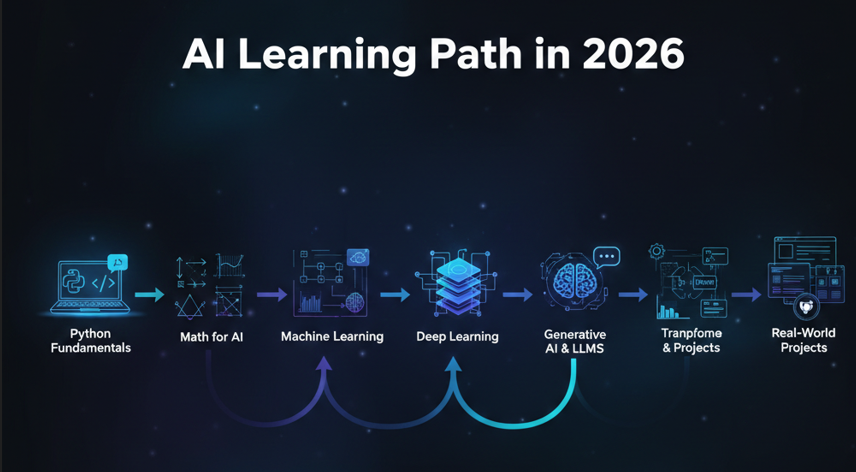
Step-by-Step AI Learning Path in 2026
This is the core roadmap that aligns with industry expectations.
Step 1 – Python for AI
Python is the foundation of almost every AI workflow. (You can also learn Python for AI for Beginners)
Focus on:
Core Python syntax
Functions, loops, and data structures
Writing clean and readable code
Essential libraries:
NumPy – numerical computing
Pandas – data manipulation
Matplotlib – data visualization
⏱ Time required: 1–2 months
This step is mandatory if you want to learn AI from scratch in 2026.
Step 2 – Math for AI (Only What’s Needed)
You don’t need deep mathematical proofs—only practical understanding.
Key topics:
Vectors and matrices
Dot products and transformations
Probability distributions
Gradient intuition (how models learn)
The goal is conceptual clarity, not memorization.
Step 3 – Machine Learning Foundations
Machine Learning the sub branch of AI, which teach the algoruhtm through data, that beomce a model. This model predict, generate differetn data and learn more and more from data. You can learn Machine Learning as beginers guide.
This is where AI becomes real.
Core concepts:
Supervised vs unsupervised learning
Regression and classification
Model evaluation and overfitting
Tools:
scikit-learn
Jupyter notebooks
Projects to build:
House price prediction
Spam detection
Customer churn analysis
This stage forms the backbone of any AI roadmap for beginners 2026.
Step 4 – Deep Learning & Neural Networks
Deep learning powers modern AI systems.
You’ll learn:
Artificial neural networks
Convolutional Neural Networks (CNNs)
Recurrent Neural Networks (RNNs)
Frameworks:
PyTorch (industry favorite)
TensorFlow
Applications:
Image recognition
Speech processing
Time-series prediction
Step 5 – Generative AI & LLMs (VERY IMPORTANT FOR 2026)
This is the most career-critical step in the AI learning path in 2026.
Key areas:
Transformers architecture
Large Language Models (LLMs)
Prompt engineering
Fine-tuning basics
Retrieval-Augmented Generation (RAG)
AI agents and automation workflows
Generative AI skills directly align with AI skills required in 2026.
Step 6 – Real-World Projects & Portfolio
Skills without proof don’t get hired.
Build:
End-to-end AI projects
Deployed applications
GitHub repositories with documentation
Include:
Problem statement
Data preprocessing
Model selection
Results and improvement ideas
A strong portfolio is essential for any AI career roadmap 2026.
AI Career Paths in 2026
AI offers multiple career directions.
AI Engineer
Builds and deploys AI systems
Works closely with production teams
Machine Learning Engineer
Focuses on model training and optimization
Handles large datasets and pipelines
Data Scientist
Extracts insights from data
Combines statistics, ML, and business logic
AI Product Engineer
Integrates AI into real products
Works with APIs, UX, and deployment
AI Freelancer
Builds AI tools and automations
Works globally with remote clients
Each role aligns with different strengths but follows the same artificial intelligence learning path 2026 initially.
How Long Does It Take to Learn AI in 2026?
This depends on consistency and goals.
Beginner level: ~6 months
Job-ready: 9–12 months
Advanced expertise: Ongoing learning
AI is not a one-time skill—it evolves constantly.
Common Mistakes to Avoid While Learning AI
Avoid these to save months of frustration:
Watching tutorials without practicing
Skipping projects
Learning tools instead of concepts
Jumping into advanced topics too early
Ignoring deployment and real-world use
Consistency beats intensity every time.
Is AI Still Worth Learning in 2026?
Yes—more than ever.
AI is becoming a core skill, similar to how computers and the internet once were. Those who understand AI will:
Work more efficiently
Build better products
Stay relevant in a rapidly changing job market
Following a structured AI learning path for beginners in 2026 gives you a massive long-term advantage.
Final Advice from Faisal Zamir
From teaching thousands of students and working closely with real-world technologies, one lesson stands out:
Consistency beats hype.
You don’t need to learn everything at once. Focus on:
Strong fundamentals
Practical projects
Continuous improvement
AI rewards those who build patiently. If you stay disciplined and follow this roadmap, 2026 can be the year you truly enter the AI field.
FAQ 1
Q: What is the best AI learning path in 2026?
A: The best AI learning path in 2026 starts with Python, followed by machine learning fundamentals, deep learning, generative AI, and real-world projects.
FAQ 2
Q: Can I learn AI from scratch in 2026 without a technical background?
A: Yes, you can learn AI from scratch in 2026 with basic programming skills, beginner-level math, and consistent practice using practical projects.
FAQ 3
Q: How long does it take to learn AI in 2026?
A: Beginners typically take 6 months to understand AI basics, while becoming job-ready usually takes 9–12 months with consistent learning.
FAQ 4
Q: Is AI still a good career choice in 2026?
A: Yes, AI remains a strong career choice in 2026 due to high demand for applied AI engineers, machine learning specialists, and generative AI experts.
FAQ 5
Q: Do I need advanced math or a PhD to learn AI?
A: No, you don’t need a PhD. Most AI roles require only basic linear algebra, probability, and conceptual understanding of how models learn.
FAQ 6
Q: What AI skills are most important in 2026?
A: Key AI skills in 2026 include Python, machine learning, deep learning, generative AI, prompt engineering, and building real-world AI projects.